Some members may experience delays or issues receiving emailed authentication codes when signing in to the myUPP Member Portal.
Please use text notifications. We are actively investigating and apologize for the inconvenience.

Climate Stewardship Plan

Addressing financially material climate risks through stewardship to support strong long-term investment outcomes for our members.

Overview

About this plan

UPP’s Climate Stewardship Plan (2026–2029) sets out how we use stewardship to help manage climate-related risks. Under the first plan (2023–2025), we strengthened how we vote as shareholders on climate-related issues, supported more consistent climate-related reporting and market standards, and expanded our engagement with portfolio companies and industry partners to encourage stronger management of climate-related risks and opportunities. Building on that progress, this plan focuses on areas we believe are most relevant to managing climate-related risks.

Published

August 2026

Table of contents

What is stewardship?

The Principles for Responsible Investment defines stewardship as “the use of investor rights and influence to protect and enhance overall long-term value for clients and beneficiaries, including the common economic, social, and environmental assets on which their interests depend.”

As outlined in our Climate Action Plan, a changing climate can create risk that affects investment performance across our portfolio, financial markets, and the broader economy. Stewardship is an important part of how we respond to financially material climate-related risks that may affect our members’ pensions, helping us fulfill our fiduciary duty to act in their best financial interests.

By advocating for effective public policy, working with companies and external investment managers, and exercising our shareholder voting rights, we encourage stronger governance, better management of climate-related risks, more transparent financial markets, and clearer climate-related reporting. These activities support investment decision-making, portfolio returns, and more resilient markets, helping to protect the pensions our members rely on.

To enhance the impact of our stewardship activities, we often collaborate with other investors and organizations that share our goal of addressing climate risk.

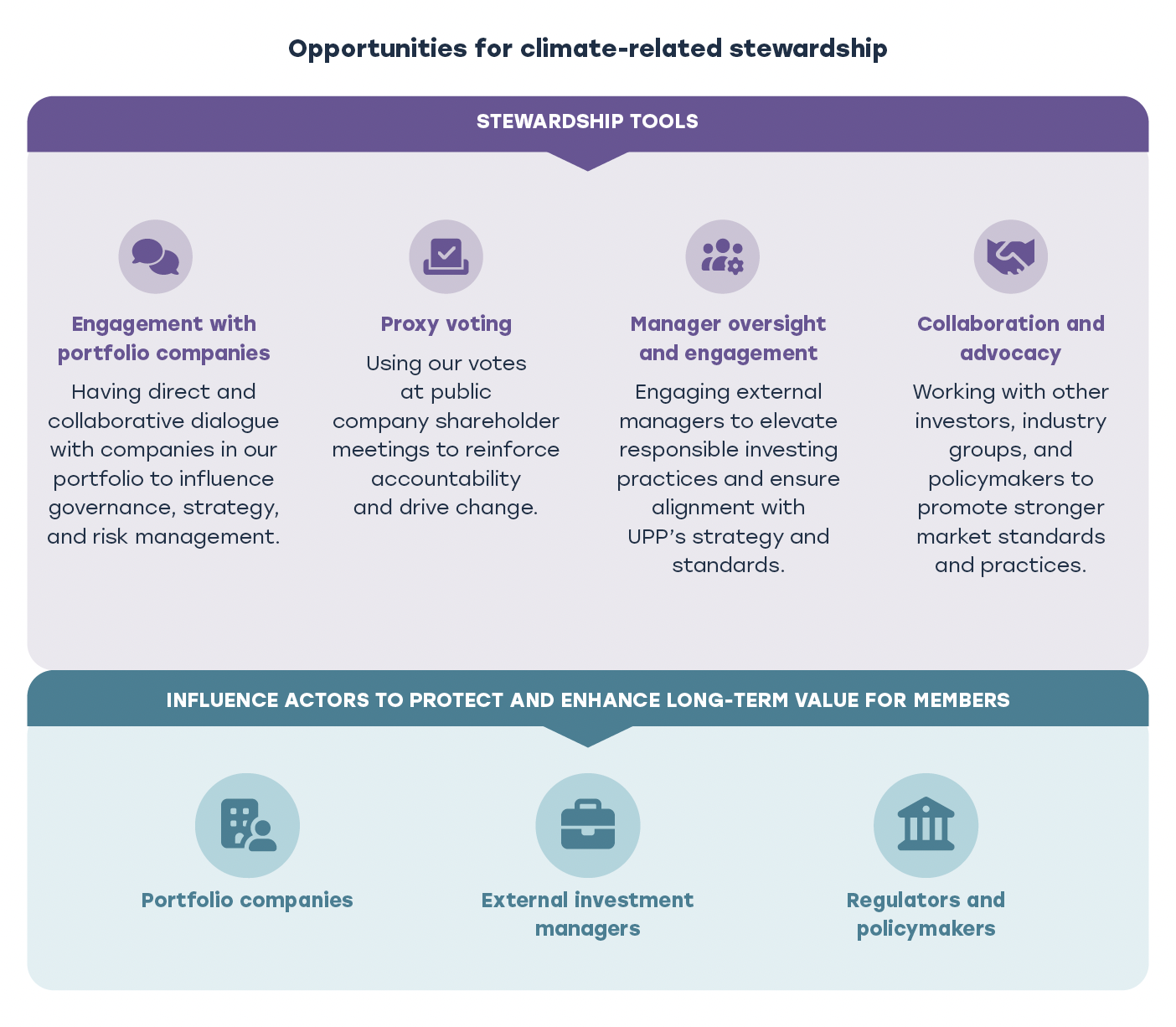
Infographic showing UPP’s climate-related stewardship tools: engagement with portfolio companies, proxy voting, manager oversight and engagement, and collaboration and advocacy. These tools influence portfolio companies, external investment managers, and regulators and policymakers to protect and enhance long-term value for members.

We will assess progress on this plan by looking for evidence such as:

  • UPP’s portfolio companies are improving how they manage climate-related risks and opportunities.
  • UPP’s external investment managers begin or continue to exercise proxy voting, company engagement, or advocacy in support of climate transition.
  • Regulators and policymakers respond to UPP’s advocacy efforts by adopting policies that improve transparency, support informed investment decisions, and enable real economy outcomes.

While no single investor can drive these outcomes alone, these indicators help us assess whether our stewardship activities are contributing to more resilient companies and markets, stronger risk management, and better information for making investment decisions.

3.0 Commitments

Approach

By engaging with regulators, policymakers, and industry peers, we encourage policies and market conditions that support better investment decisions, strengthen market resilience, and create opportunities to invest in the transition to a lower-carbon economy.

Effectively managing climate-related risks requires market rules and public policies that provide investors with clear information, stable investment conditions, and opportunities to invest in the transition to a lower-carbon economy. UPP engages with regulators and policymakers independently and alongside other investors to help shape these conditions in support of long-term investment outcomes.

Our approach is guided by the Net-Zero Asset Owner Alliance (NZAOA)’s Policy Engagement Guidelines. We also collaborate with peers and organizations such as Ceres, New Economy Canada, and the Principles for Responsible Investment (PRI) to amplify our collective voice.

Commitments

  • Advocate the adoption of climate-related disclosure requirements aligned with Canadian and international reporting standards.
  • Support the development and implementation of Canada’s green and transition taxonomy through participation in advisory bodies and consultation processes.
  • Advocate for effective, economically sound, and science-based carbon pricing and methane regulation in Canada.
  • Promote industrial policies that strengthen climate resilience and create investment opportunities in areas such as critical minerals, clean electricity, and nature-based solutions.

Consistent, decision-useful climate-related disclosure

The Canadian Sustainability Standards Board (CSSB) is a standard setting organization that has developed climate and sustainability-related disclosure standards for Canadian organizations based on the global standards developed by the International Sustainability Standards Board (ISSB). Together, these standards provide a common framework for companies to report material climate-related risks, helping UPP and other investors make more informed long-term investment decisions. Visit CSSB and ISSB websites to learn more.

Canada’s green and transition taxonomy

Canada’s green and transition taxonomy is being developed to provide a common classification system for identifying economic activities and investments that support the transition to a lower-carbon economy. By establishing consistent definitions and criteria, the taxonomy is intended to improve transparency, reduce uncertainty, and help investors identify transition-aligned investment opportunities while supporting Canada’s emissions reduction goals. Learn more through the Canadian Taxonomy Roadmap Report.

3.2.1 External investment managers

Approach

By working closely with external investment managers, we encourage the consistent integration of climate-related considerations across a larger portion of UPP’s portfolio to support investment decision-making and long-term investment outcomes.

UPP’s in-house investment team works alongside external investment managers to implement our public market investment strategies. Through ongoing collaboration, we deepen our understanding of climate-related risks and encourage best practices in stewardship and investing across a larger portion of our portfolio.

We encourage our external managers to engage with portfolio companies, integrate climate considerations into their proxy voting activities, and support climate-aligned public policy. We also identify opportunities to collaborate on shared priorities, extending our collective influence as long-term investors.

Commitments

Take a proactive approach to working with our external investment managers by:

  • Initiating discussions on relevant proxy votes, portfolio companies, sectors, or thematic issues where we see opportunities to address climate-related risks.
  • Promoting the adoption of robust and comprehensive climate stewardship practices.
  • Identifying opportunities for managers to provide input to market standard-setters, regulators, and industry bodies on climate-related topics.

3.2.2 Portfolio companies

Approach

Our goal is to help companies make better long-term decisions that support more resilient businesses and stronger investment outcomes.

UPP regularly meets with portfolio companies to encourage stronger management of climate-related risks. We focus our efforts where we believe dialogue can have the greatest impact on managing climate-related risks, prioritizing companies based on factors such as portfolio exposure, emissions intensity, opportunities to support the transition to a lower-carbon economy, and where progress can be measured over time.

Commitments

  • Through our partnerships, selectively engage with high-emitting sectors.
  • Encourage priority companies to adopt climate-related disclosures aligned with the CSSB, develop credible transition strategies, and integrate climate considerations into capital allocation decisions.
  • Work with audit and accounting firms, company management, and boards to strengthen the integration of climate considerations into financial reporting and audit practices.
  • Continue supporting the efforts of Climate Engagement Canada (CEC) to strengthen climate risk management across the economy through contributions to its governance bodies and company dialogues.

Climate Engagement Canada (CEC)

CEC is an investor-led initiative that supports climate progress at high-emitting publicly listed Canadian companies through collaborative investor engagement and climate benchmarking. By working together, participating investors can help encourage stronger climate disclosure, transition planning, and governance practices at companies where climate risk is financially material. Learn more from Climate Engagement Canada.

Approach

As a shareholder in publicly traded companies, we use our voting rights to encourage companies to make decisions that strengthen long-term performance and better manage financially material risks, including climate.

Our Proxy Voting Policy states our positions and expectations of companies in the form of guidelines on key topics, and our votes are publicly disclosed on our proxy voting page. By reinforcing our expectations through our votes, we aim to encourage company decisions that strengthen long-term performance and support resilient investment outcomes.

While climate considerations are already well integrated into UPP’s proxy voting approach, we continue to strengthen how climate-related issues are reflected in our voting decisions.

Commitments

  • Support shareholder proposals that call on companies to provide climate-related disclosures that apply the CSSB or ISSB standards.
  • Communicate with priority companies when we vote against management on climate-related matters to explain our voting rationale and encourage improvement.
  • Maintain dialogue with external managers to share UPP’s voting priorities and assess their voting practices.
  • Continue to strengthen the integration of climate considerations into UPP’s proxy voting policy, informed by emerging research, evolving market practices, and new technologies.
  • Monitor developments related to nature-related risks and update our proxy voting guidelines, where appropriate.

4.0 Progress

We will monitor our progress against the commitments set out in this plan and report publicly on our activities and outcomes. This plan will be reviewed over time to reflect evolving market developments, lessons learned, and emerging priorities.

Overview

Stewardship

At UPP, we conduct climate-related stewardship through:

  • Engagement: engaging with companies in our portfolio and our external investment managers through direct and collaborative dialogue to support their transition to a resilient, low-carbon, and net-zero business strategy.

  • Proxy voting: using our shareholder rights to vote for initiatives that support the net-zero transition and elect boards that provide adequate oversight of climate-related risks and opportunities.

  • Advocacy: advocating for policies and regulations consistent with the goals of the Paris Agreement , including mandatory climate and transition plans.

We collaborate with like-minded partners that share our climate goals, and with our external asset managers, to enhance the impact of our stewardship.

What is stewardship?

“Also known as ‘active ownership’, stewardship is the use of influence by institutional investors to maximise overall long-term value including the value of common economic, social and environmental assets, on which returns and clients’ and beneficiaries’ interests depend.”

— UN Principles for Responsible Investment 

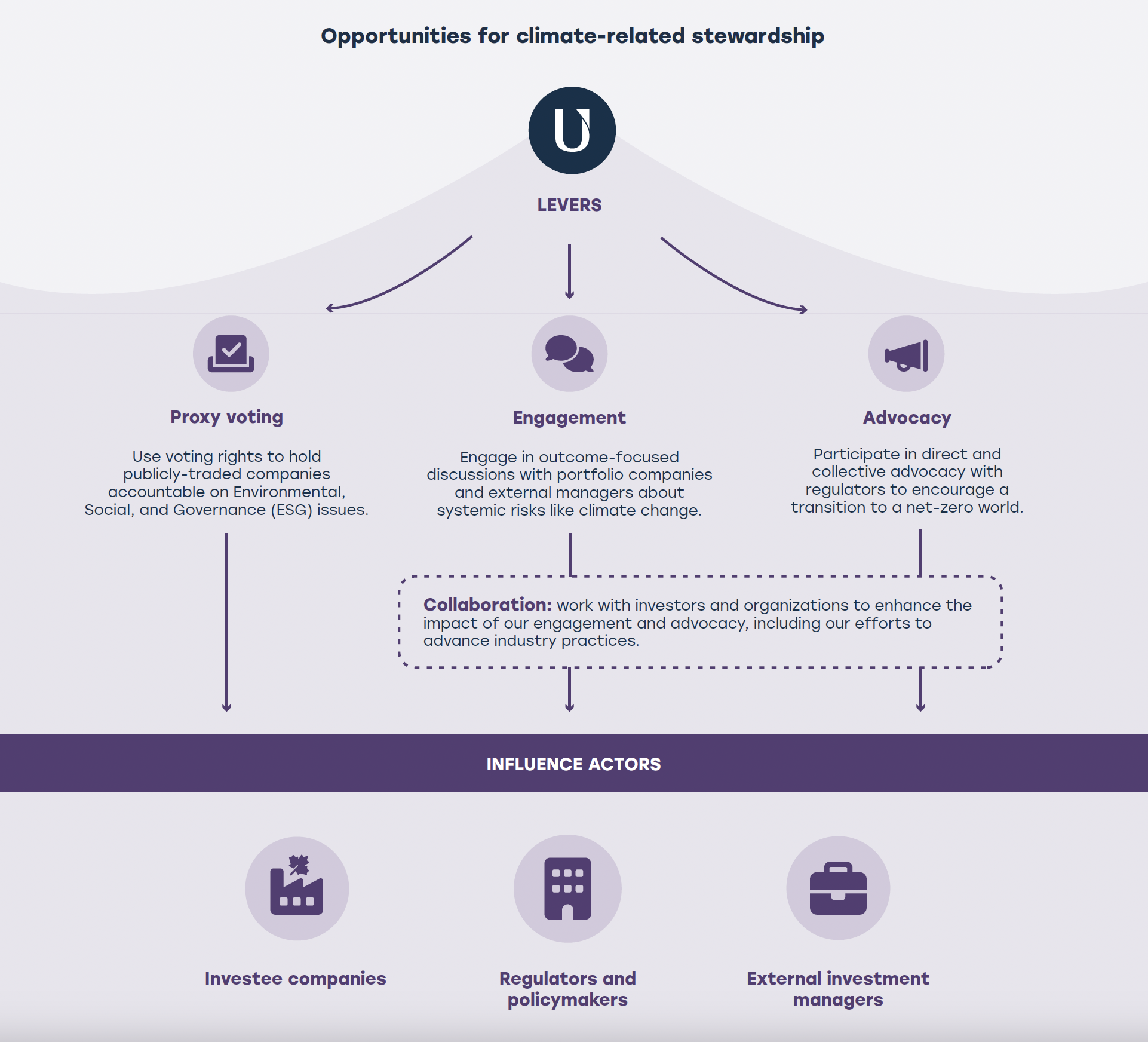
This graphic illustrated opportunities for climate-related stewardship. Proxy voting, engagement, and advocacy levers are used to influence actors including investee companies, regulators and policy makers, and external investment managers.

Measures of success

While no single institution can claim success when a company, policy maker, or investor takes concrete steps to address climate-related systemic risks, we will measure the success of UPP’s contributions by assessing progress on indicators such as:

  • Following engagement by UPP, high climate-impact companies reduce their emissions in line with credible pathways, and proactively manage their transition to net zero by 2050.

  • After UPP’s advocacy, regulators implement policy tools to support management of climate risks and opportunities.

  • UPP’s external managers exercise proxy voting, company engagement, or advocacy in support of climate transition, following our dialogue with them.

Commitments

Engagement

We have selected 27 companies across three categories as the focus of our engagement activities: banks as important allocators of capital that will shape climate transition, high-emitting Canadian companies where UPP engagement can add value, and oil companies with an outsized impact on UPP’s carbon footprint. When selecting companies we considered:

  • company size and weight in UPP’s investments,

  • opportunities for engagement,

  • materiality of the companies to UPP’s carbon footprint,

  • importance of the companies to real economy climate transition, and

  • availability of metrics and data to measure progress.

Our engagement goals and approaches for each of the three company categories are outlined below.

Banks – allocators of capital that shape climate transition

Goals:

  1. Set and disclose interim and long-term targets for reducing financed and facilitated emissions, consistent with a 1.5°C pathway.

  2. Disclose exposure to high-emissions sectors.

  3. Set and disclose against targets to scale up finance towards climate solutions and 1.5°C aligned assets.

Engagement approach:

UPP will participate in collaborative engagement with the banks through the Institutional Investors Group on Climate Change (IIGCC) and through our engagement service provider, SHARE . We will assess progress annually based on results of the Transition Pathways Initiative Net Zero Banking Assessment report , company disclosures, and SHARE engagement reporting.

High-emitting Canadian companies

Goals:

  1. Set and disclose long-term and interim science based GHG reduction targets covering at least 95% of Scope 1 and 2 emissions (direct operations and purchased energy) and material Scope 3 emissions (indirect from upstream and downstream value chains).

  2. Establish a decarbonization strategy/transition plan that explains how the company intends to meet these GHG reduction targets.

Engagement approach:

UPP will engage with the companies through Climate Engagement Canada (CEC) and SHARE. We will assess progress annually based on results of the CEC Net Zero Benchmark , information from our external managers, company disclosures, and SHARE engagement reporting.

Oil companies with outsized carbon footprint impact

Goals:

  1. Set and disclose long-term and interim GHG reduction targets covering at least 95% of Scope 1 and 2 emissions (direct operations and purchased energy) and material Scope 3 emissions (indirect from upstream and downstream value chains).

  2. Establish a decarbonization strategy/transition plan that explains how the company intends to meet these GHG reduction targets.

  3. Commit to conduct direct and trade association policy advocacy in line with the goals of the Paris Agreement and provide disclosure to demonstrate alignment.

Engagement approach:

We will conduct bilateral engagement with the companies through targeted written requests for information about their alignment to the Climate Action 100+ Net Zero Benchmark or the CEC Net Zero Benchmark . We will evaluate the responses we receive, and refine UPP’s position on ongoing investment in these companies as appropriate.

Proxy voting

As a shareholder in publicly traded companies, we use our voting rights to communicate expectations and hold companies accountable on governance issues, including those related to climate change.

Our Proxy Voting Policy states our positions and expectations of companies in the form of guidelines on important ballot issues focused on enhancing the long-term economic interests of shareholders. Our votes are publicly disclosed on our proxy voting page.

Goals

Through the proxy voting-related actions in this Plan, we seek to:

  1. Focus our votes on climate performance in addition to disclosure.
  2. Amplify the impact of our votes through communication.


Action Plan

2023: Initiate votes against directors

  • Vote against all incumbent directors where there appears to be little to no board oversight of climate-related issues.
  • Write to Canadian companies when we vote against management recommendations for climate-related reasons.
  • Propose revisions to our guidelines and process to enable voting against directors on inadequate evidence of climate action.


2024: Escalate with strengthened guidelines

  • Share updated proxy voting guidelines with all external managers.
  • Execute votes in accordance with the revised guidelines.
  • Write to climate engagement focus companies and Canadian companies when we vote against management recommendation for climate-related reasons.
  • Consider revisions to our guidelines to integrate climate-related expectations on other ballot items such as auditor appointment, advisory votes on compensation, and corporate transactions.


2025: Communicate votes to amplify impact

  • Systematically highlight our climate-related vote guidelines to external managers.
  • Execute votes in accordance with the revised guidelines.
  • Pre-declare votes for one or more climate-related ballot item.
  • Write to climate engagement focus companies, Canadian companies, and select international companies when we vote against management recommendation for climate-related reasons.
  • Consider further refinement of our guidelines and approach.

We believe that UPP has a duty to advocate for effective rules and regulations on behalf of our members for the good of the fund and for the good of the economic, social, and environmental systems on which long-term fund performance relies.

Effectively managing a systemic issue like climate change requires market regulation to facilitate and incentivize behaviour consistent with addressing the challenge. UPP selectively communicates with regulators and policymakers—either independently or with like-minded peers—to encourage fair and efficient public policy, government regulations, and market systems that support a well-managed transition to a net-zero world and UPP’s broader sustainability objectives.

Goals

Through our climate policy advocacy, we aim to:

  1. Contribute to establishment of mandatory standardized, economy-wide disclosure of scope 1, 2 and material scope 3 emissions, and transition plans from all medium and large enterprises.
  2. Support policy advancing the alignment of activity in the real economy with a 1.5 degrees scenario.


Advocacy approach

We will advocate for the regulatory interventions necessary to ensure near complete coverage of Canada’s economy with climate-related financial disclosures. UPP will also support development of a Canadian green and transition taxonomy and the domestic adoption of the International Sustainability Standards Board standards. Where capacity permits UPP will support industrial policy that facilitates real economy transition and express concern with policies that are misaligned. In doing so UPP will refrain from partisanship or statements that could be perceived as partisan.

UPP will prioritize advocacy on policy issues in Canada. However, we will monitor and from time to time may provide input to international regulatory frameworks and standards where we believe that our voice will have meaningful impact, including by actively participating in collaborative investor action networks and initiatives .

Related reports

Part of being a responsible investor is advancing climate readiness across our portfolio. Our Climate Action Plan details UPP’s commitment and path to net-zero portfolio emissions by 2040 or sooner, with an emphasis on decarbonizing the real economy.

The Climate Transition Investment Framework was created to support the commitments outlined in UPP’s Climate Action Plan. It supports our ability to manage the impacts of climate-related risks on fund performance and capitalize on opportunities for long-term value creation.

Feedback

We are always looking for ways to improve your experience. Please tell us about your experience below.

Your responses will be kept confidential. To protect your privacy, please do not enter your account or personal information.

Customize your experience through accessibility adjustments